

There’s a version of Greece that most tourists never see.
It doesn’t show up on a group tour. You won’t find it on a cruise itinerary. And Google Maps won’t suggest it unless you already know where you’re going.
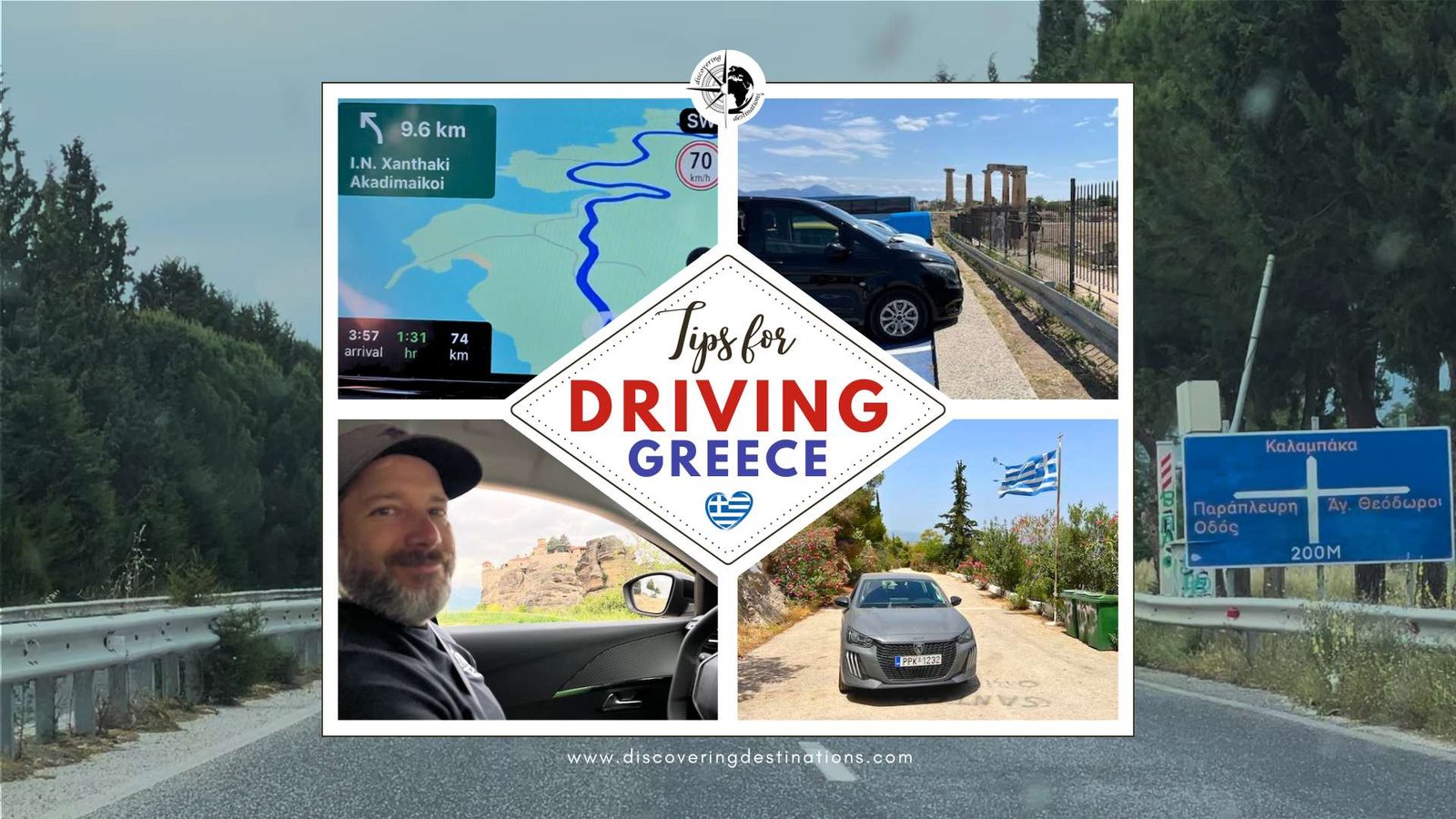
We found it by renting a car and just… driving.
Over 25 days in May 2024, we road-tripped across the Greek mainland and islands — Athens, the Peloponnese region, Santorini, Meteora, Delphi, and a long list of places we didn’t plan for.
Most of that wouldn’t have happened without a car — the hidden sea caves explored by canoe, a fortified island city we’d never heard of, a waterfall one hour off the main highway that became one of the best memories of the entire trip.
But we also made mistakes — circled Athens for twenty minutes looking for parking, arrived in Santorini at 10pm on unlit mountain roads, paid a toll booth twice because Serge dropped the coins too fast.
That said, this post is everything we wish we’d had on day one — the real tips, the honest mistakes, and the places that made the trip worth it.
Keep reading, or if you’d rather watch the full experience, Serge put together a complete driving vlog covering all 25 days on the road in Greece — toll booths, island ferries, hidden gems and all.
👉 Do you prefer read this on the go? Grab our free Greece driving guide → and save it to your phone before your trip.
DISCLOSURE NOTE: 👉 Our Blog Post contain few affiliate links to products We personally use, trust, and suggest. These help support our efforts in creating valuable and informative content.
When you make a purchase or engage with our affiliate partners through these links, we may earn a small commission at no extra cost to you. Your support enables us to continue producing quality content and exploring new topics. Thank you for being a part of our journey and helping us grow! Sharing is caring ! Click here to learn more.
Is It Worth Renting a Car in Greece?
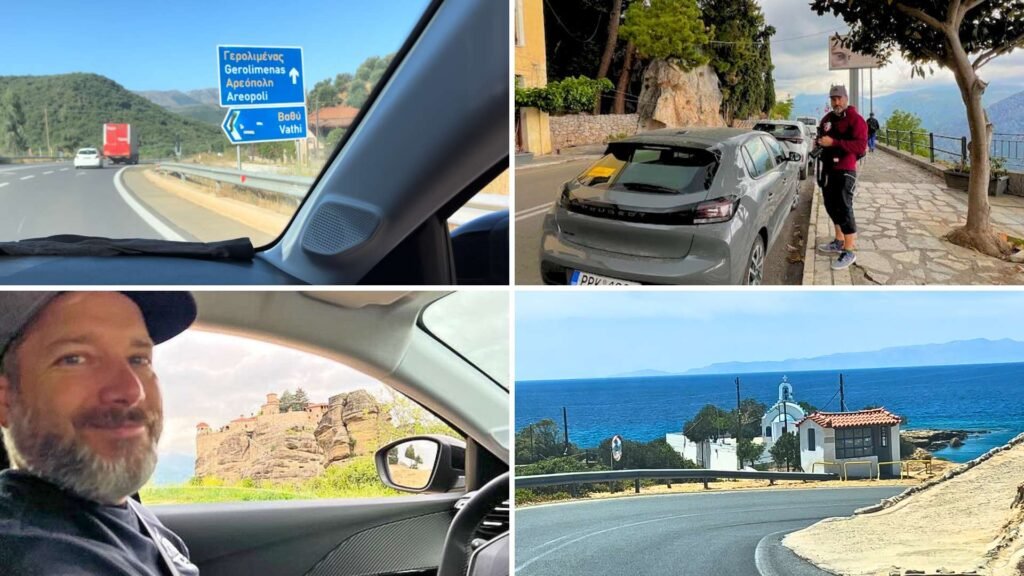
Short answer: yes. Emphatically.
But it depends on the trip you’re planning.
If you’re sticking to Athens and Santorini, you honestly don’t need a car. Athens has solid public transport, and from there you’ll find plenty of day tours covering Corinth, Delphi, and even Meteora — we put together a full list in our day-trips guide. Browse Athens day trips on GetYourGuide → is also useful for comparing routes and prices before committing to a car rental. For a city-focused trip, a rental car is more hassle than it’s worth.
But if you want to go beyond the postcard version of Greece, that’s where renting a car changes everything.
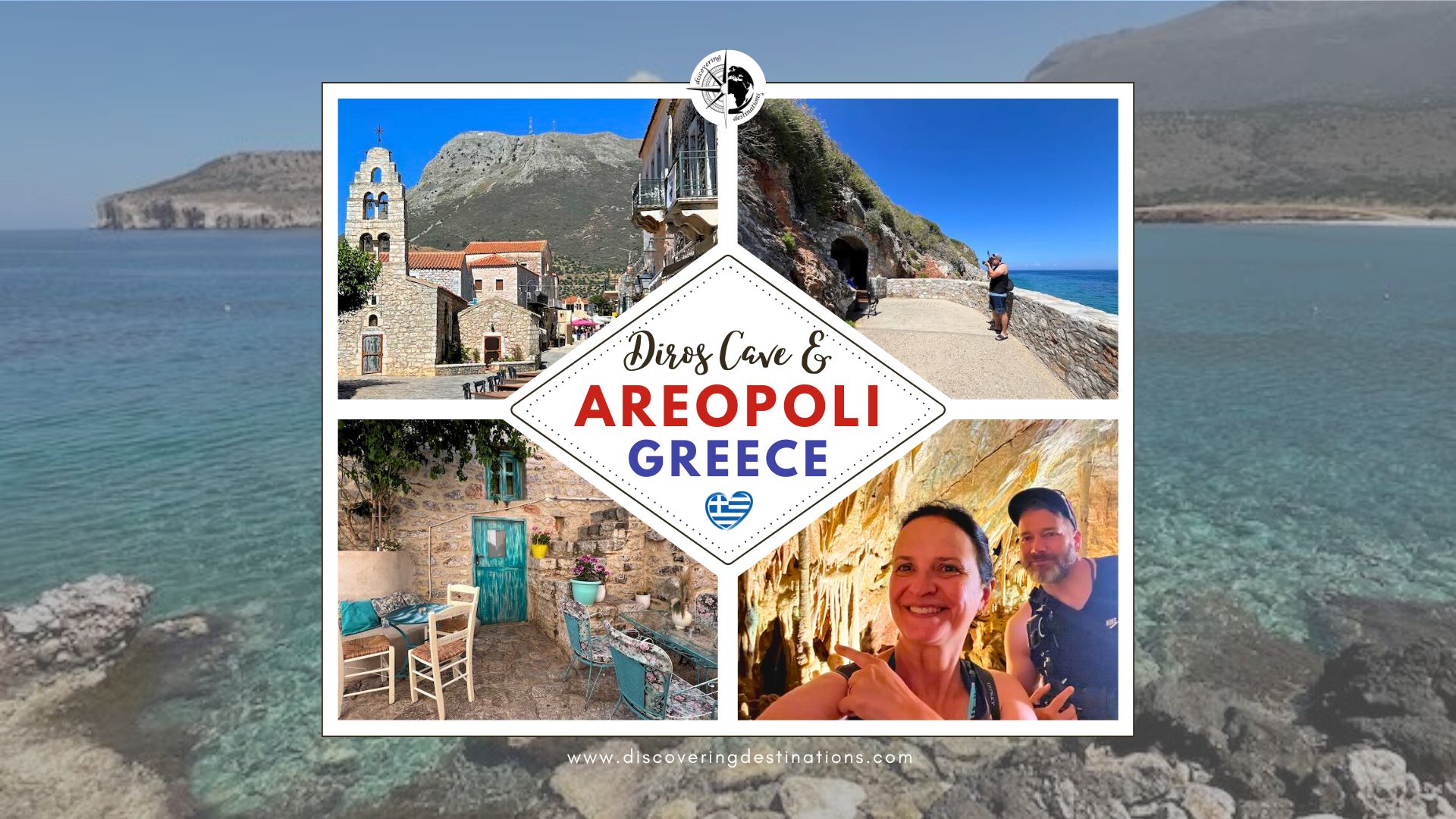
Places like the Peloponnese, Elafonisos, the Diros Caves, and Monemvasia aren’t on any tour bus route. Neither is the quiet coastal highway where you’ll suddenly pass a shipwreck on a beach. Getting there requires your own wheels and the freedom to follow a road and see where it goes.
The same applies on the islands. Ferries connect them, but once you’re there, a car or ATV is what gets you away from the crowds and into the places worth actually photographing. One tip from experience: bringing your rental car on the ferry to Santorini is possible, but it adds a significant cost to your crossing. Our recommendation is to leave the car on the mainland, take the ferry as a passenger, and rent a car or ATV directly on the island once you arrive. You’ll find plenty of rental options at the port — and your wallet will thank you.
If you have the time and the curiosity to explore beyond the tourist trail, renting a car in Greece is absolutely worth it. Here’s everything you need to know before you pick up the keys.
What to Know Before You Pick Up the Keys
Do You Need an International Driver’s Permit to Drive in Greece?
This was our first question before the trip, and it almost cost us unnecessary time and money.
As Canadians, we assumed our French-language license might be a problem. It wasn’t. During our May 2024 road trip, Canadians did not need an International Driver’s Permit (IDP) to drive in Greece. Neither do travellers from the US, UK, Australia, and most other non-EU countries — your standard driver’s license is generally accepted.
That said, requirements can change. Always confirm with the official Greek tourism authority or directly with your car rental company before you go. Your rental company will tell you exactly what they need at pickup.
Our tip: Bring a printed copy of your license alongside the original. We were never asked for it — but it’s free peace of mind.
Car Rental Insurance in Greece: What’s Included, What’s Not
Every rental car in Greece comes with basic third-party liability insurance — that’s the legal minimum, and every rental company is required to include it.
What basic insurance doesn’t always cover: damage to the car itself, theft, or tire damage on the rocky roads you will absolutely end up on in Greece.
We chose to add extra coverage every time. It adds a small daily cost but removes the anxiety of every tight village street, every rocky beach parking spot, and every narrow mountain road where you’re squeezing past a truck. Without extra coverage, most rental companies will hold a deposit on your credit card — sometimes several hundred euros — which ties up funds for the duration of your trip.
Our recommendation: think about your driving style and your risk tolerance. If you’re confident on narrow European roads and you’re not planning to park on loose gravel beside the Aegean, basic may be fine. If you’re less experienced with driving abroad, the upgrade is worth every cent.
How we book rental cars in Europe:
For our own trips, we use Auto Europe — it’s our go-to for European car rentals and has been reliable across multiple countries including Greece. They work with trusted local and international agencies and the booking process is straightforward.
If you prefer to compare options across multiple platforms before booking, Discover Cars is a solid tool — it lets you filter by transmission, insurance level, and car size, and shows local Greek rental agencies alongside the bigger international brands side by side.
Either way, book in advance for Greece in peak season. Availability in smaller regions fills up fast.
eSIM and Mobile Data: Non-Negotiable
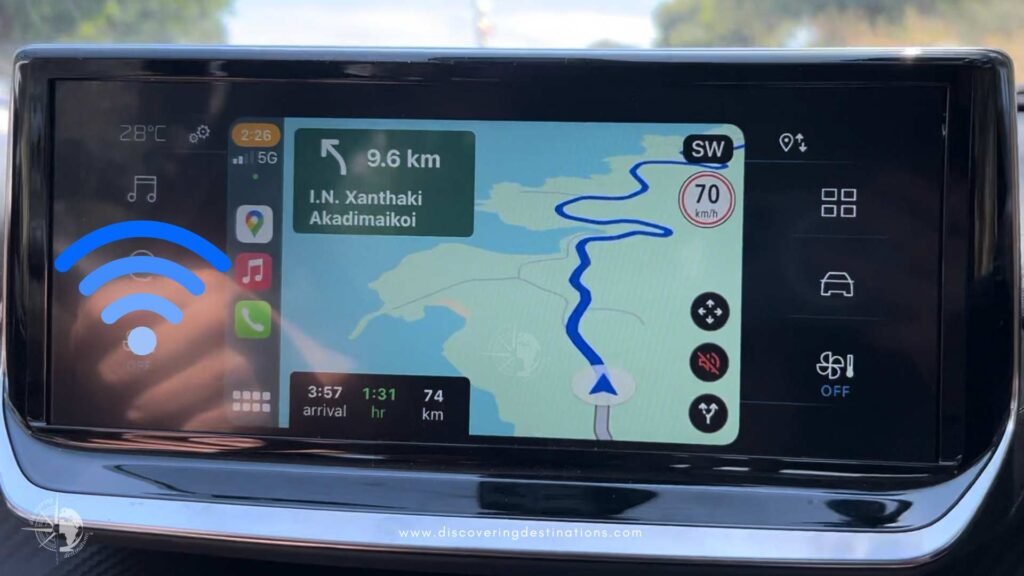
Set up internet before you land. This is not optional.
Greek road signs in rural areas are frequently written only in Greek. Without Google Maps or Waze running in real time, you are navigating by intuition — and intuition doesn’t know that the road to Diros is the one that looks like someone’s driveway.
During our May 2024 trip we used Airalo — you install the eSIM before you fly, activate it on arrival, and you have local data immediately. No SIM card swapping, no roaming charges, no hunting for a phone shop at the airport.
Since then we’ve switched our go-to eSIM provider to Holafly after running into coverage issues in other destinations. Holafly offers unlimited data plans which suits the way we travel, and coverage has been consistently reliable across Europe.
Both work well for Greece. Airalo tends to be more flexible on shorter data plans, Holafly is our current pick for unlimited coverage on longer trips.
Our tip: whichever you choose, install and test it before you leave home. The last thing you want is to troubleshoot an eSIM in an Athens parking garage.
Stay Connected Wherever You Travel
We’ve used Holafly eSIM in Morocco and other destinations around the world, and it gave us reliable coverage with no roaming surprises. It helped us check transport, stay in touch with family, and share our journey as we traveled.
👉 Use our discount code DISCOVERINGDESTINATIONS
Enjoy 5% off any Holafly plan, for any destination, on your next purchase.
Pick the Right Car Size
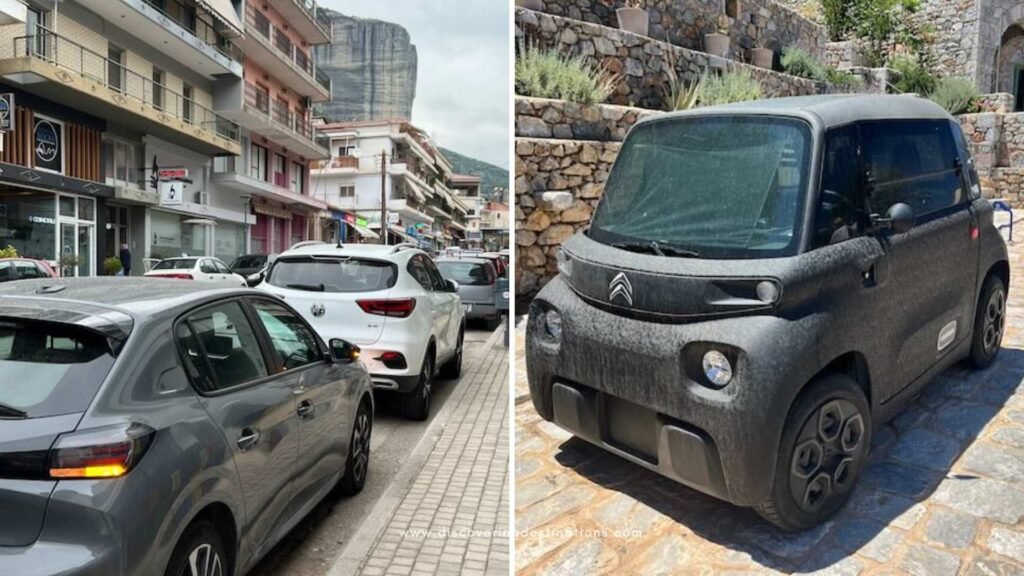
Go smaller than you think you need.
The roads in Greek villages, the parking spots at Meteora, the lanes on the Mani coast — they were not engineered for a mid-size SUV. A compact car will fit into spaces that would require a six-point turn in anything larger, and you’ll thank yourself for it every single time.
If you have a lot of luggage, consider packing lighter rather than sizing up the car. The trade-off is absolutely worth it.
And we’re not the only ones saying it — a local viewer on our YouTube channel put it perfectly: “You’ll definitely have a much more relaxing drive in a smaller car.” Hard to argue with that.
What Driving in Greece Actually Feels Like
The Basics
Greece drives on the right side of the road, with the driver’s seat on the left — same as North America, most of Europe, and most countries you’ve likely driven in. Switching sides is not a concern here.
Road signs use international symbols, so the standard warnings, speed limits, and direction signs are immediately readable. In cities and on major tourist routes, signs are bilingual (Greek and English). On smaller regional roads, particularly in the Mani and on the way to Delphi, you’ll encounter signs in Greek only — which is exactly why you set up that eSIM before you left.
Toll Roads in Greece: What to Expect
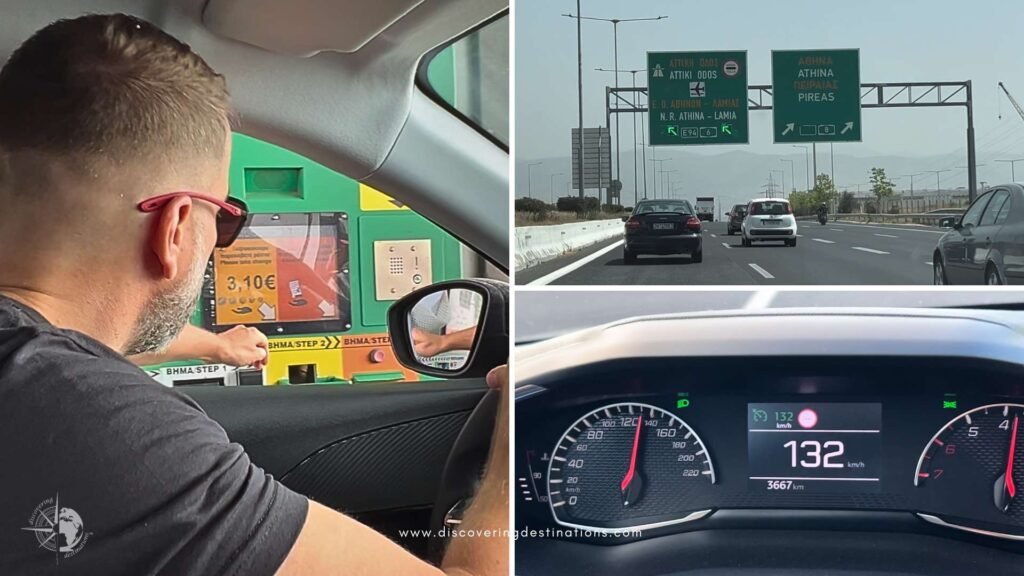
The main highway network connecting Athens, Patras, Corinth, and Meteora is modern, well-maintained, and fast. Speed limits go up to 130 km/h, the pavement is smooth, and the signage is clear.
These highways have tolls. Here’s what you need to know because we spent the first two days confused:
Three lane types at every toll booth:
- Yellow lane: For vehicles with a transponder device. Skip this — you won’t have one as a tourist.
- Blue lane: A staffed booth. Someone hands you change. Easiest option, especially at the beginning of the trip when you’re still finding your rhythm.
- Green lane: A self-pay basket. Drop in coins and the gate opens. The machine gives back change — which we didn’t figure out until day three. Until then we kept queueing for the blue lane like textbook tourists.
Important: At the green lane, wait for the gate to fully close after the car ahead before dropping your coins. If the gate is still up from the previous car, the machine doesn’t register a new vehicle. Serge learned this the hard way and paid twice at one booth.
Tolls Pro tips:
- plan your toll costs before you leave: We used Toll Guru to estimate both toll costs and fuel consumption for each leg of the trip. It’s free, it covers Greece specifically, and it helped us budget accurately before we even picked up the car. Type in your route and it breaks down every toll booth along the way with the expected cost. Genuinely useful and something most travel blogs don’t mention.
- Keep small coins — €1 and €2 — and a few €5 bills easily accessible in the car at all times.
Smaller Roads and Regional Highways in Greece
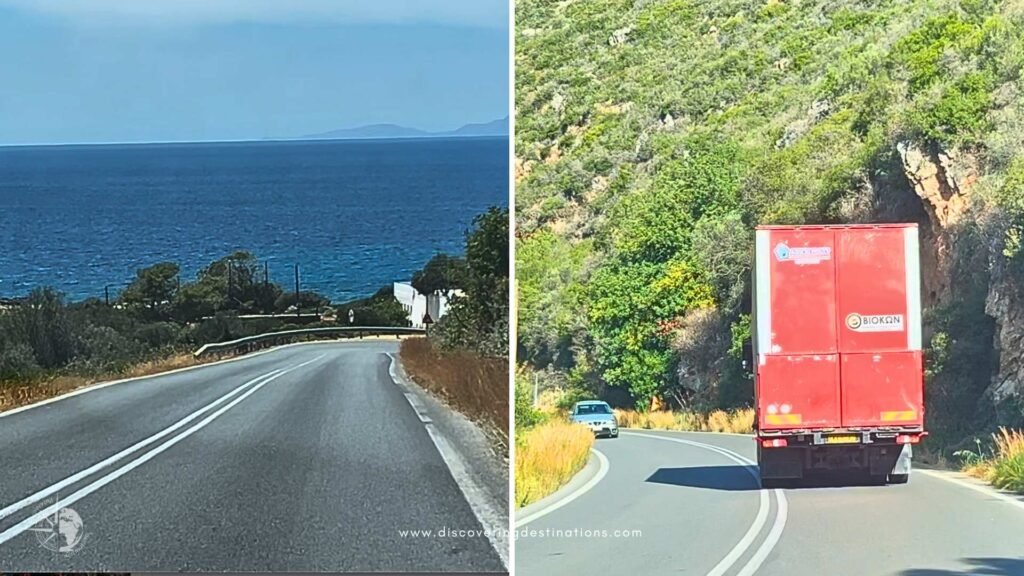
Here’s where it gets interesting.
Once you leave the main toll highways, Greek roads narrow considerably. Two-lane regional roads often have no shoulder, limited passing opportunities, and the occasional stretch that feels more like a suggestion than an actual road.
Local drivers tend to drive more assertively than you might be used to. Passing on solid white lines is common. We watched cars overtake each other on blind corners in the Mani. Trucks drift onto the shoulder to let faster drivers pass — that’s a local courtesy, not an accident waiting to happen.
The good news is that it gets easier. By day five the driving style had normalized and we’d found our rhythm: drive defensively, hold your lane, and when a faster car is behind you and there’s space, ease onto the shoulder and let them pass. It’s the local way, and it works.
A word of caution — and this applies beyond Santorini:
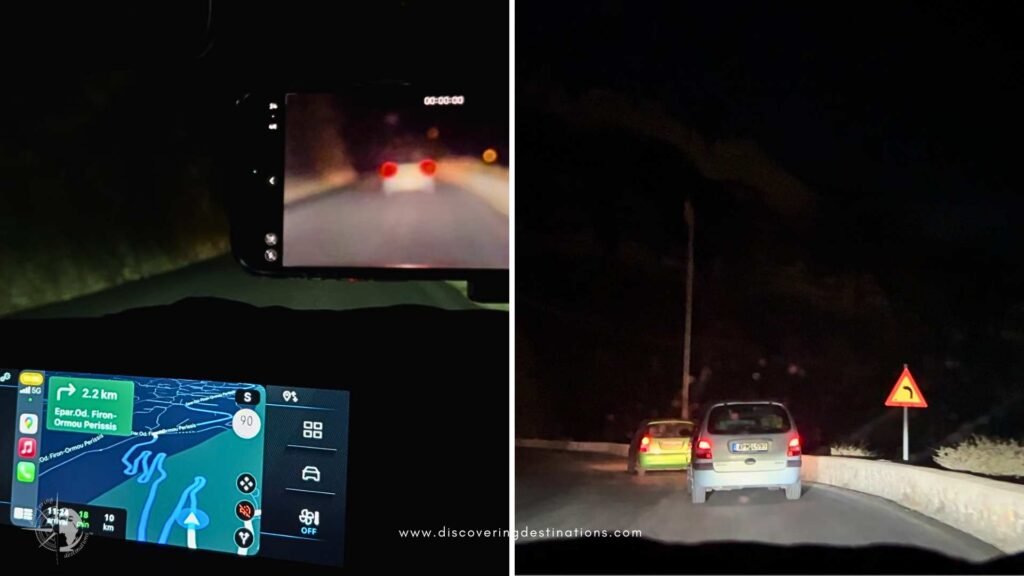
Emma, the manager at our hotel in Santorini, pulled us aside before our first drive on the island.
“Please be careful,” she said. “There are a lot of fatal accidents here.” She wasn’t being dramatic — she was being practical.
Santorini gets the most attention because the combination of narrow cliff roads, poor lighting at night, and a flood of tourist drivers every summer creates a genuinely risky environment. But the same awareness applies anywhere in Greece where the roads are narrow, the signage is minimal, and the locals know the roads far better than you do — the Mani peninsula, the mountain roads near Meteora, the inland routes on Crete and Rhodes.
The caldera views are spectacular. The mountain scenery is worth every kilometer. Just keep your eyes on the road and save the sightseeing for when you’ve pulled over safely.
A few habits that helped us throughout the entire trip:
- Drive slower than you think you need to on unfamiliar roads
- Avoid driving in new areas after dark until you know the route
- Pull over to check Google Maps rather than glancing at your phone while moving
- If the road feels wrong, it probably is — trust that instinct and find an alternative

Parking in Greece: City by City
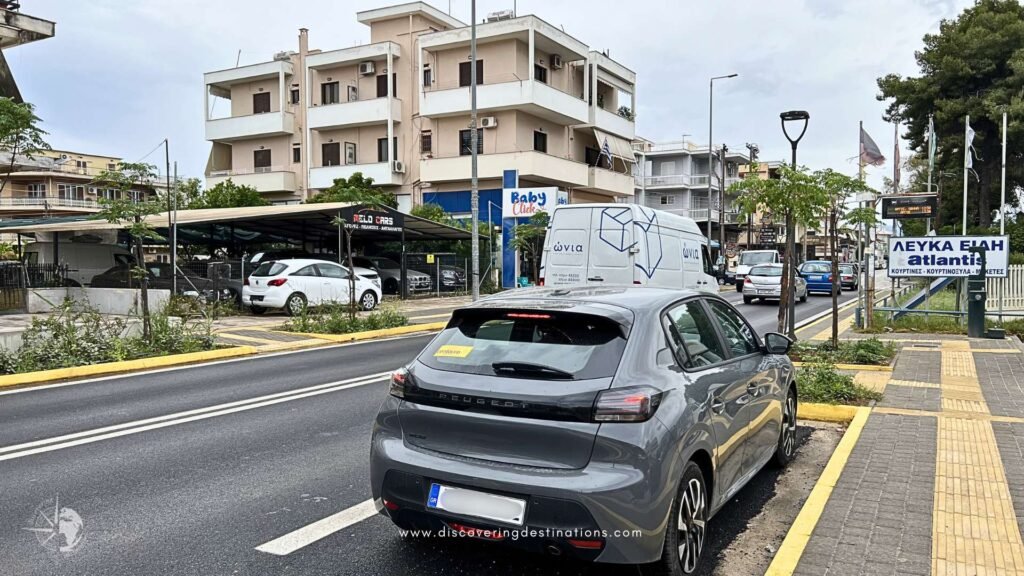
Greece surprised us with how much parking varies from one place to the next. What works in Nafplio won’t work in Athens, and what works in Athens won’t work at Meteora.
Over 25 days we drove through more cities and villages than we can cover in one post — but below are the ones we spent the most time in, and the ones most travelers are likely to visit. Think of this as a starting point, not an exhaustive guide. The full breakdown, including smaller towns and regional parking notes, will be in our upcoming 25-Day Greece Road Trip eBook.
Athens
Here’s a mistake we made before we even arrived.
When searching for accommodation in Athens we filtered for “hotels with parking” — sounds logical, right? What we didn’t realize is that most hotels near the historic center don’t have actual parking. The “parking” they advertise is usually just street parking nearby, not a secured indoor garage. That filter also pushed our results away from the center, which created a whole new problem.
We ended up parking at a hotel garage further out, still had to pay a premium, and then faced a 45-minute walk or metro ride to the historic center — exhausting when you only have two days in the city.
What we’d do differently: skip the hotel parking filter entirely. Search for accommodation near the historic center, then find a dedicated indoor parking garage separately. Park the car on arrival and leave it there. Almost the entire historic center is pedestrian-only anyway — you won’t need it.
The Athens metro is excellent — fast, cheap, air-conditioned, and it connects to every major site you’ll want to visit.
👉 Planning where to stay in Athens? We wrote a full hotel guide covering luxury to budget options — read it here.
👉 Arriving in Athens? Skip the airport rental pickup. If your first night is in central Athens, take a metro or pre-booked transfer to your hotel and pick up the car on your way out. It saves the headache of driving into Athens jet-lagged. Pre-book an Athens airport transfer →
Santorini
We visited Santorini with our rental car — something we wouldn’t necessarily recommend, simply because taking a car on the ferry from Athens adds a significant cost to your crossing. If you’re budget-conscious, leave the car on the mainland, cross as a foot passenger, and rent a car or ATV directly at the port when you arrive.
That said, having a car on Santorini was genuinely wonderful. It gave us the freedom to go beyond the obvious — past Oia and Fira — and discover hidden gems that locals pointed us toward. Places with almost no other tourists in sight. If you want to see that side of Santorini, wheels matter.
👉 Watch our Santorini hidden gems vlog to see exactly where we went.
Don’t have time to drive? GetYourGuide offers Santorini hidden gems and caldera tours that cover several of these spots in a half-day.
If you are driving in Santorini, here’s what to know about parking:
Oia: Don’t drive into Oia. Search “Oia parking” on Google Maps, leave the car in one of the general lots on the village perimeter, and walk in. The streets inside are too narrow for most cars, local delivery trucks need them more than tourists do.
One important note if you’re staying inside Oia: cars are not permitted in certain areas of the village. Contact your hotel in advance and ask about luggage drop-off logistics before you arrive. It will save you a stressful moment on arrival day.
Fira, Pyrgos, and most other villages: the same rule applies. General parking lots are almost always available on the village edges — they’re just not always clearly signposted. Check Google Maps before you arrive at each village, not when you’re already in the middle of it.
Where we stayed: We booked Aegean Melody Suites — a quieter location slightly outside Oia and Fira, but with parking included. Since we had the car, the distance was never an issue, and it actually worked in our favor. Our hotel manager Emma knew the island inside out and pointed us toward hidden spots we never would have found on our own.
For more Santorini hotel recommendations by location and budget, read our full guide: 👉 Best Hotels in Santorini — Top Locations and Recommendations
A note on timing: If you’re taking the ferry from Athens with your car, consider the timing carefully. We arrived at Santorini at 10pm after a 6-hour crossing and then drove to our hotel in the dark. The highways on Santorini have almost no streetlights. The roads are narrow. We made it fine, but the drive was tense in a way it didn’t need to be. If you can time your arrival in daylight, do it.
Meteora
Meteora is one of the most extraordinary places we visited in all of Greece, and honestly, one of the most extraordinary places we’ve visited anywhere. The monasteries perched on top of massive rock formations near the town of Kalambaka are the kind of sight that stops you mid-sentence.
If you’re staying in Kalambaka, finding a hotel with parking is straightforward — the town is well set up for visitors with cars. We did exactly that, and it made the early morning monastery visits much easier to manage.
👉 For hotel recommendations and a full Meteora travel guide, read our dedicated post: Meteora, Greece — A Spiritual Haven
Parking at the Monasteries
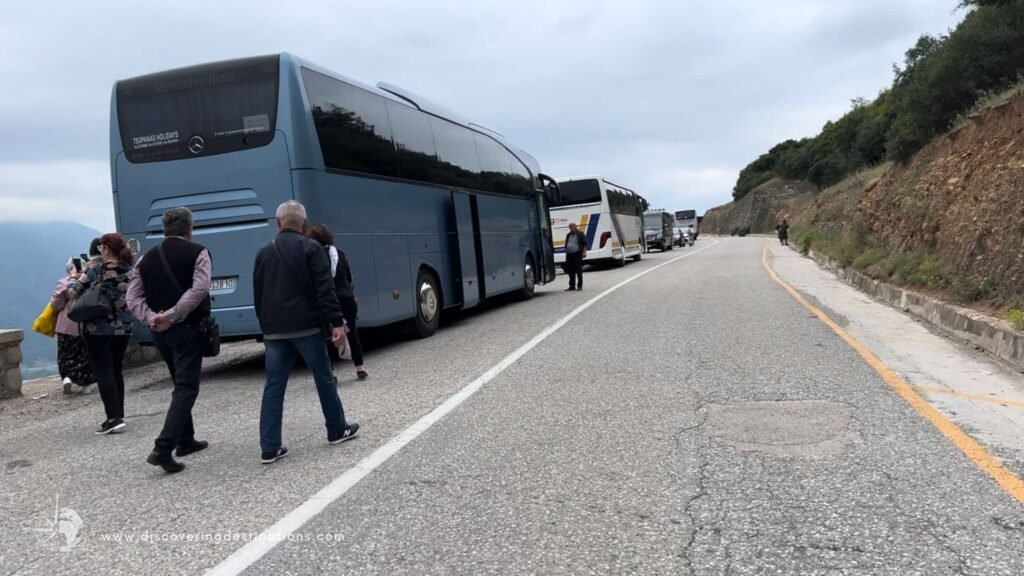
Here’s what no one tells you clearly enough: there is no formal parking at Meteora’s monasteries. The road that winds up through the rock formations is narrow, and “parking” means finding a shoulder wide enough to squeeze onto without blocking traffic.
We visited over two days. On the first afternoon we arrived later than planned — the monasteries were already open and the road shoulders were lined with cars. We ended up parking further down and walking up, which was fine but tiring given the steps involved.
The next morning we arrived 30 minutes before opening, thinking we were being smart. The shoulders were already starting to fill. Meteora draws crowds earlier than you’d expect.
The practical solution: Use the drop-off strategy. Drive to the monastery entrance, let most of your group out at the door, then find a parking spot down the hill and walk back up. The steps at every monastery are steep — you’re getting a workout either way, so the extra walking from the car barely registers.
Additional tips we’d add from experience:
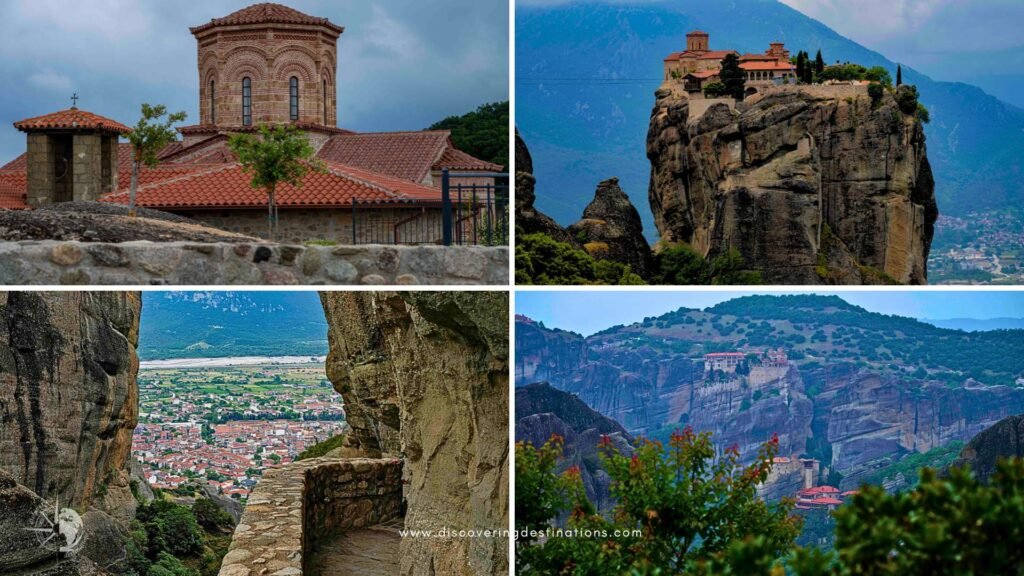
Check opening days before you go. This is the one that catches most visitors off guard. Meteora has six monasteries and each one closes on a different day of the week. If you show up on the wrong day you’ll find a locked gate. Check the schedule for each monastery the night before and plan your order accordingly.
Budget entrance fees in cash. Each monastery charges a small entrance fee — around €3 per person. Have cash and small coins ready. Don’t assume card payment is available.
Dress code is strictly enforced. No bare shoulders, no shorts. Women are required to wear a skirt inside — some monasteries provide wraps at the entrance but don’t count on it. Pack a light scarf or sarong in the car and you’ll never have an issue.
The drive itself is part of the experience. There are several viewpoints along the road between monasteries where you can pull over safely and photograph the rock formations without the crowds at the monastery gates. Some of Serge’s best shots from the entire Greece trip came from these pull-offs, not from inside the monasteries themselves.
Holy Trinity Monastery is worth the extra effort. It requires crossing a narrow bridge and climbing steep steps cut into the rock — but it’s the one featured in the James Bond film For Your Eyes Only and the views from the top are unlike anything else at Meteora.
Sunset from Kalambaka town is underrated. After a full day at the monasteries, driving back down and watching the light change on the rocks from the town below costs nothing and requires no parking strategy at all.
Parking Greece – Other Cities and Towns
We drove through many more cities and towns over 25 days — Nafplio, Areopolis, Corinth, Kalamata, and others. Parking varied everywhere but was generally manageable once we understood the local rhythm.
For our full city-by-city driving and parking impressions from the road, watch our complete Greece driving vlog — Serge covers each destination in real time, including the moments that surprised us most.
👉 Watch: Driving in Greece — 25 Days on the Road →
Taking Your Car on the Ferry in Greece
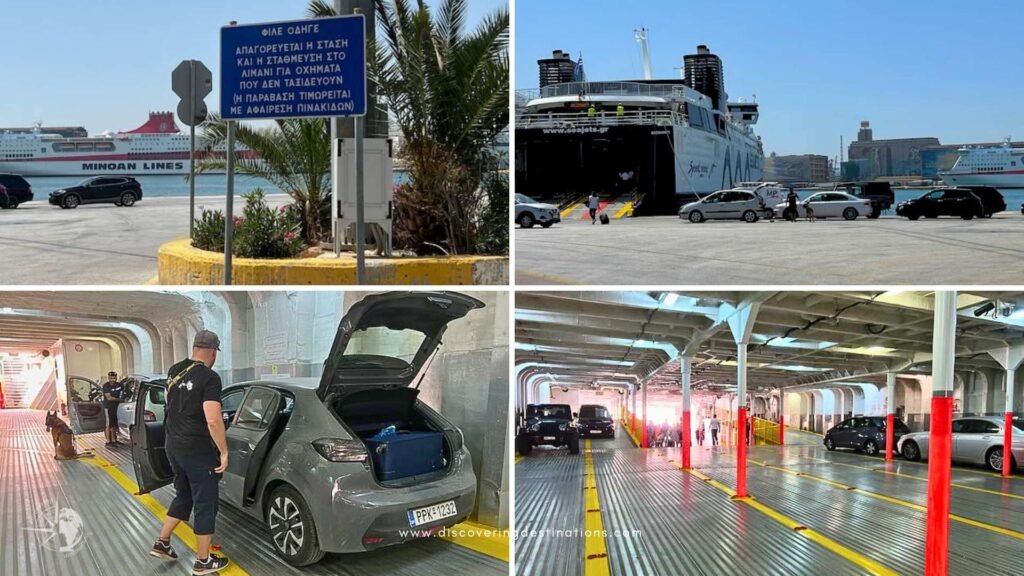
We only did this once — Athens to Santorini — so consider this a first-timer’s account rather than an expert guide.
A few things we wish someone had told us before we drove to Piraeus:
Your ferry ticket may not show the gate number. This almost caught us off guard. We arrived at the port with no idea which gate to go to — the ticket listed the departure time and company but nothing else. We found the SeaJets kiosk nearby and they pointed us straight there. Simple fix, but factor in extra time at the port just in case. We now use Omio to book ferry crossings in Europe — the booking confirmation is clearer and it covers routes across multiple countries in one place.
Drive-on/drive-off is straightforward. Staff guide you to your spot on the car deck and direct you off on arrival. The only unexpected moment was disembarking on a slightly rough sea — the ramp felt unstable for a second. Nothing serious, just worth knowing if you’re not expecting it.
One honest note: as we mentioned earlier, bringing your car on the ferry adds significant cost. Unless you specifically want the flexibility of your own car on the island, renting locally once you arrive is the smarter financial decision.
👉 Compare Greece ferry routes and book online → (Omio)
The Hidden Gems We Only Found Because We Had a Car
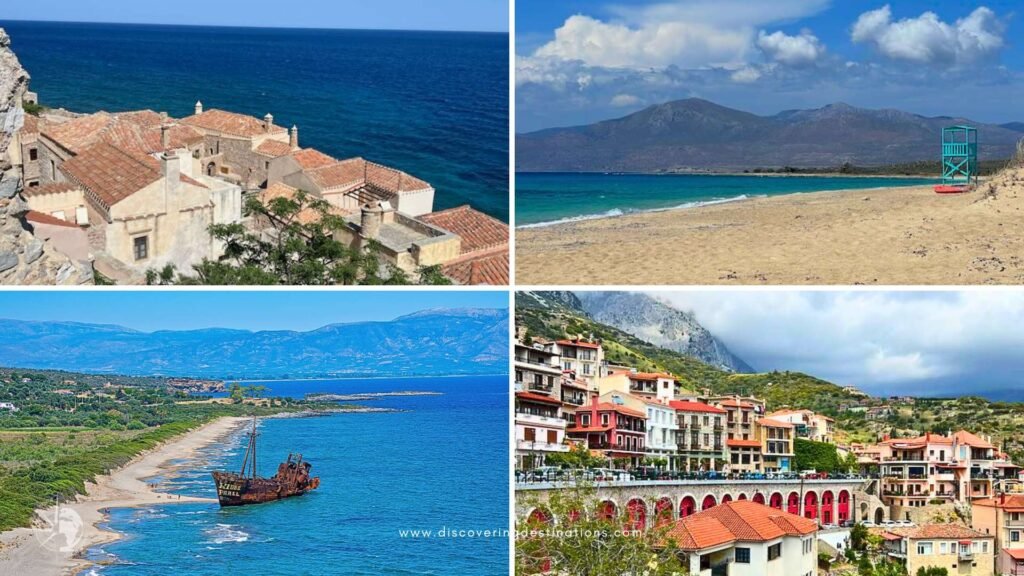
This is the part we want every Greece traveler to hear.
None of these places were on our original itinerary. Every single one was a discovery, either from a local recommendation, a spontaneous turn, or just following a sign to see where it led.
Monemvasia: We had absolutely no idea this place existed until we drove past a sign for it. A fortified medieval city built on an island, connected to the mainland by a single narrow causeway — it reminded us immediately of Mont-Saint-Michel in France. We checked into our hotel and went straight there. No regrets.
Elafonisos and Simos Beach: Locals in the Mani told us this was the beach — not a beach, the beach. Getting there requires regional roads and a short ferry crossing, which is exactly why most tourists skip it. We did not skip it.
The Shipwreck Near Diros: Visible from the highway. A rusting ship hull resting on a beach, as if it just came to rest there one day and no one ever moved it. We didn’t stop because we were running behind schedule. We still think about it.
Arachova: On the way to the archaeological site of Delphi, we drove through this mountain village and fell in love immediately. We parked the car and spent two unplanned hours walking the stone streets. If you’re going to Delphi — and you should be — add at least an hour for Arachova. You’ll thank yourself.
These are just four of the places that surprised us most. Our free Greece driving guide includes more hidden stops, practical tips, and everything you need to plan your own road trip discoveries.
And if you want the complete picture — every stop, every route, every restaurant and hotel from our full 25 days on the road — we’re putting it all into one place:
Join the Waitlist for Our 25-Day Greece Road Trip eBook →
👉🏼 Full itinerary, driving notes, hidden gems with directions, parking tips by destination, and everything we’d do differently next time. Coming soon.
PIN THIS POST to save it for your Greece trip planning ⤵️
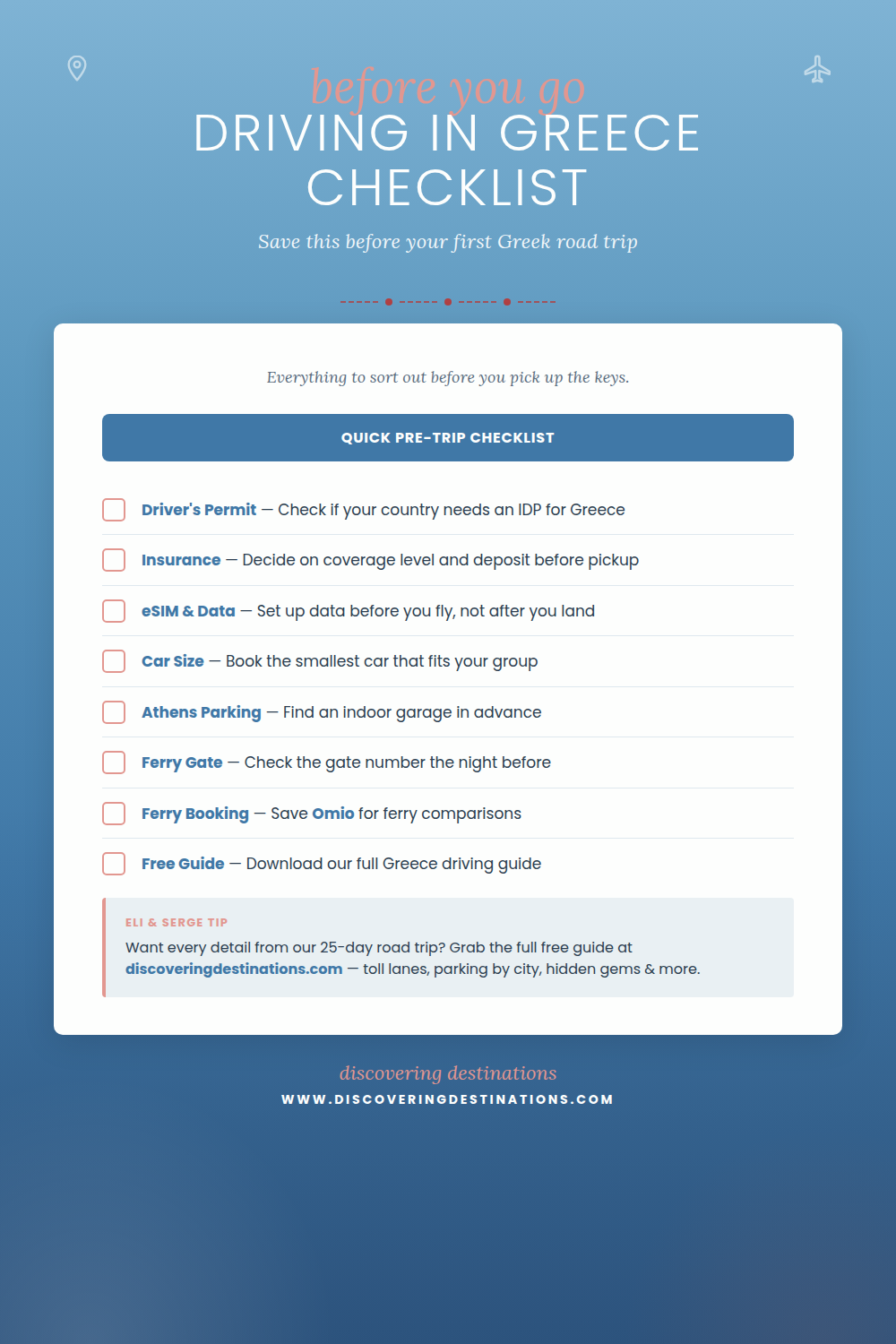
👉 Click the checklist to download the printable PDF — or hover and save to Pinterest.
Final Thoughts
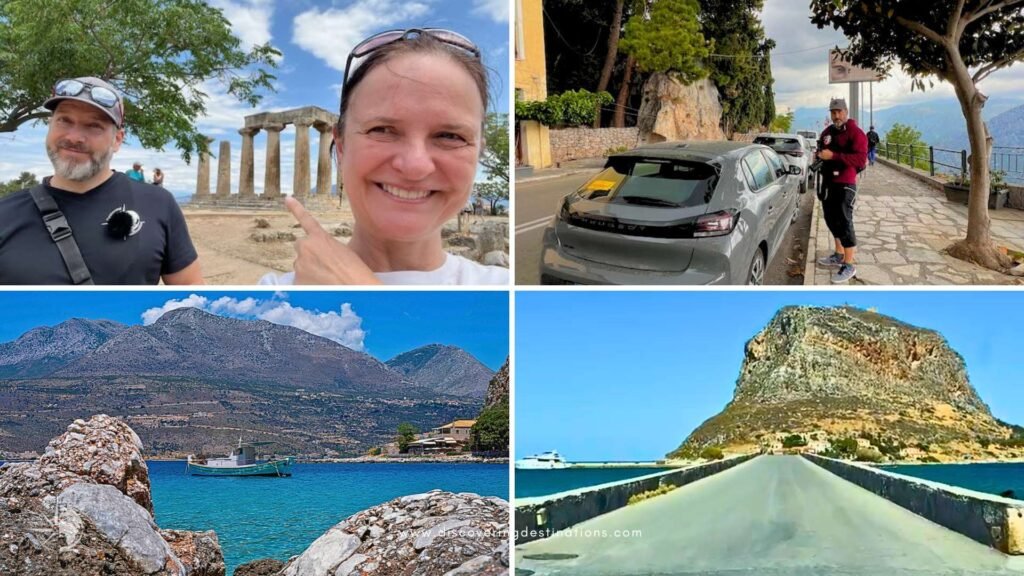
Driving in Greece changed the trip for us.
Not in a stressful way — in the way that a detour through a mountain village at golden hour changes a trip. In the way that arriving at a hidden beach with no tour bus in sight changes a trip. In the way that the freedom to slow down, pull over, and explore something unexpected changes a trip.
The mistakes we made were small and fixable. The discoveries were permanent.
If you’re on the fence about renting a car in Greece, we hope this post tips you over it.
Watch our full Greece driving vlog on YouTube — we cover all of this in real time, with footage from the toll booths, the Santorini night drive, the Meteora parking situation, and every hidden gem above.
Eli & Serge are the creators behind Discovering Destinations, a travel blog and YouTube channel based in Montreal. They’ve traveled to 30+ countries and document the real version of every trip — the discoveries, the mistakes, and everything in between.
Did you find this guide helpful? Leave your questions or comments below—we’d love to hear from you!

Eli & Serge from Discovering Destinations
Discovering Destinations: Travel Tools & Planning Tips
Traveling is exciting—but a well-planned trip can make the experience smoother and more affordable. We’ve learned through years of travel that starting early helps you find the best deals, avoid stress, and make the most of your time.
Use trusted tools to compare prices, read real traveler reviews, and book with confidence. From flights and hotels to eSIMs and local tours, these platforms have helped us—and now they can help you too.